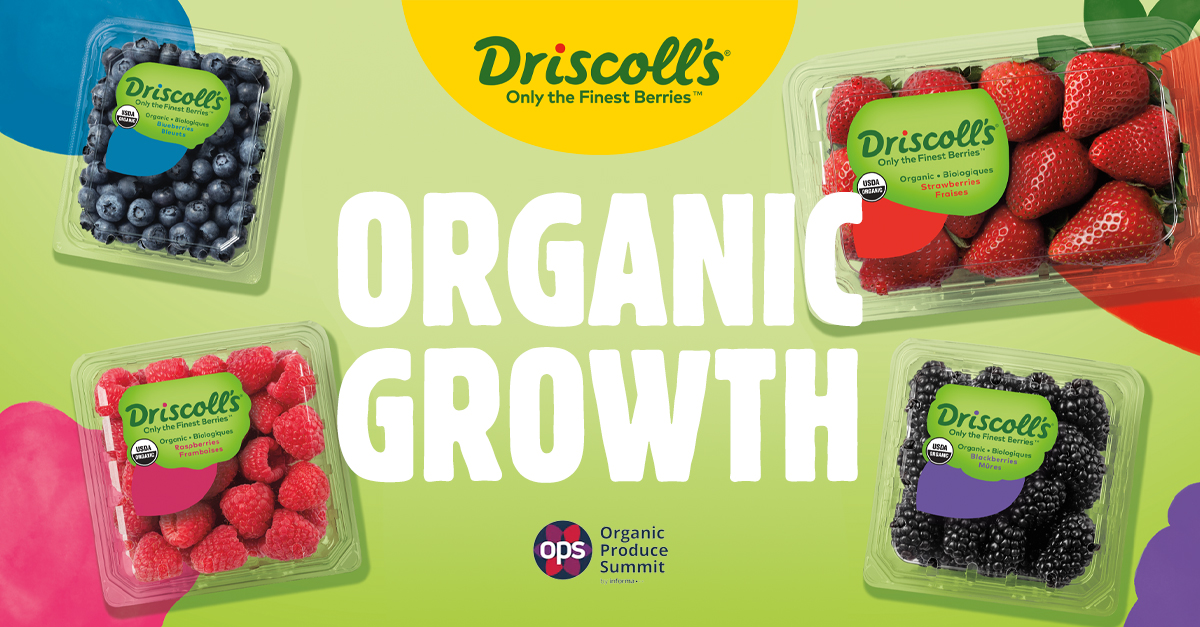
WATSONVILLE, CA - As we prepare for the 2026 Organic Produce Summit (OPS), now is the perfect time to reflect on the amazing growth that has taken place in the organic segment. In the berry category specifically, Driscoll’s is one supplier that is leading the charge.

“Driscoll’s entered into organics in the late 1980s at a time when consumer demand for food grown without synthetic inputs was still emerging,” Garland Reiter, Jr., Chief Commercial Officer, began telling me. “By 1997, Driscoll’s had established certification with California Certified Organic Farmers (CCOF), embedding rigorous standards, third-party verification, and continuous improvement. Organic was not treated as a niche product line, but as a distinct production system requiring new agronomy, closer coordination with growers, and a deeper investment in soil health, biodiversity, and long-term farm resilience.”
According to Garland, Driscoll’s built the organic business by listening to the consumer. He explained that Gen Z and millennials now buy organic produce more often than any older cohort, and they are the most willing to pay a premium relative to other generations. For these consumers, organic reflects a broader focus on health, transparency, and how food is produced. That shift is visible in the category itself: Berries are now the No. 2 organic produce category in the U.S. by volume, and have delivered growth that outpaces most leading organic produce categories in recent years.

“At the same time, availability and price remains a barrier for many consumers reinforcing that the opportunity ahead is not to create demand, but to build the supply at the right place to meet it. Retailers can drive organic berry growth by positioning organic offerings at the first point of purchase within the berry display and using clear merchandising cues that reduce shopper friction and accelerate product discovery,” Garland continued.
He noted that organic berries are more complex to produce, with lower yields, higher costs, and fewer tools to manage disease, pests, and weather. Expanding supply, while improving efficiency and affordability, is the central challenge for the industry.
“Driscoll’s addresses that constraint through genetics, geography, and production technology. Its breeding program focuses on naturally vigorous, disease-resistant varieties that perform under organic conditions,” Garland explained. “It matches crops to geographies where climate and soil conditions naturally reduce pest and disease pressure. And it invests in evolving production systems that can improve resource efficiency and support earlier, more reliable output for growers.”
Driscoll’s teams and independent growers focus on soil health through crop rotation, cover crops, and composting. They use beneficial insects instead of synthetic pesticides and manage biodiversity through farming practices that support pollinators and natural pest control.

“Looking ahead, Driscoll’s sees organics not as a niche, but as a critical component of the future of fresh produce. The opportunity is not simply to grow more organic berries, but to build more resilient and efficient systems that make organic more accessible to more consumers over time,” Garland pointed out. “As the segment scales, there is a clear path toward improving efficiency and narrowing the price premium that today limits broader adoption.”
Driscoll’s has also articulated a long-term aspiration to expand organic production in key growing regions—an effort that would require sustained collaboration across growers, communities, and public partners.
The organic segment demonstrates Driscoll’s continued promise to deliver exceptional berries while building a system that works better for people and the land. For a closer look at what the supplier is doing to create a more formidable category, be sure to stop by the booth at OPS.
Companies in this Story

Driscoll's
Family-owned for over 100 years, Driscoll's is passionate about growing premium fresh berries. Our strawberries,…