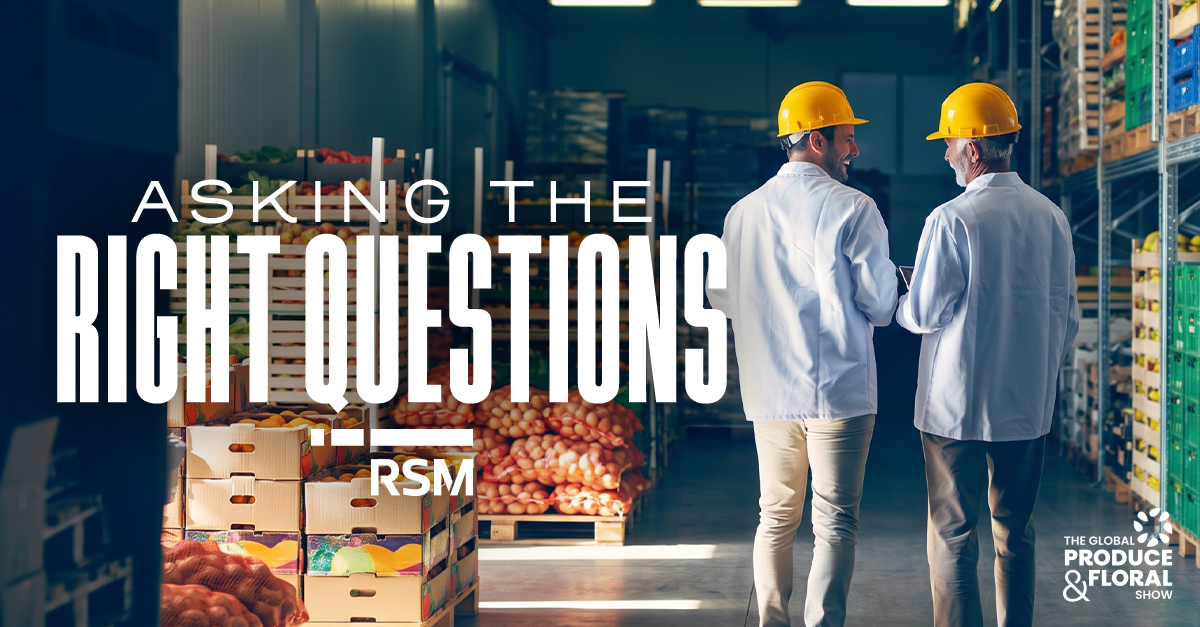
ORLANDO, FL - I love this concept. Most people know what outcome they want for their businesses, but the map that guides many of them to those solutions is, at best, conceptual, if not a distant aspiration. When a company goes out of its way to guide you, I find the legwork that follows to be that much more enjoyable and rewarding.
As RSM's Kevin Head, Director of Food and Beverage, tells me, it is all about knowing the questions to put to the task. And even more, finding the right company to answer them.
Join Kevin has he gives us the technology questions worth asking at the 2026 IFPA Global Produce & Floral Summit...

Every technology provider has an answer.
The harder part is knowing which questions to ask.
That challenge is becoming increasingly important across the produce industry. As organizations navigate margin pressures, labor shortages, evolving compliance requirements, and rising customer expectations, technology decisions can have a lasting impact on future growth and performance. As leaders prepare for IFPA 2026, they should look beyond product demonstrations and software features. The most valuable conversations often explore business outcomes, operational priorities, and long-term strategy.
Here are several technology questions produce leaders should consider asking at IFPA 2026.
Is Your ERP Helping the Business Grow or Creating Limitations?
Many produce businesses have relied on the same systems for years. In some cases, those solutions have been heavily customized, while others operate across multiple disconnected platforms that were implemented to solve specific challenges over time.
The question is whether those systems are still supporting business goals.

An ERP platform should provide visibility across finance, operations, inventory, procurement, and supply chain activities. When teams rely on spreadsheets, manual workarounds, or duplicate data entry to complete critical processes, it may indicate that the technology environment is no longer aligned with organizational needs. Technology providers should be able to explain how their solutions support the unique requirements of produce operations, including inventory tracking, grower accounting, food safety, forecasting, and supply chain management. More importantly, they should demonstrate how the technology can scale as the business grows.
The best ERP discussions focus on business outcomes rather than software capabilities alone.
What AI Use Cases Are Delivering Measurable Value Today?
Artificial intelligence continues to dominate technology conversations, but many organizations are still determining where practical value exists. Rather than asking what AI can do, produce leaders should ask what AI is already doing.
Strong answers should move beyond theoretical possibilities and focus on measurable business outcomes. Examples may include automating repetitive administrative tasks, improving reporting processes, accelerating data analysis, enhancing forecasting, or helping employees access information more efficiently. Solutions such as Microsoft Copilot are generating interest because they can help employees spend less time searching for information and more time acting on it. However, successful AI adoption typically starts with specific business challenges rather than broad experimentation.
Technology providers should be able to identify realistic use cases that address operational needs and explain how organizations can measure success.

How Connected Is Your Technology Ecosystem?
Many produce businesses operate across multiple systems that manage customer relationships, inventory, finance, logistics, food safety, and reporting. The challenge arises when those systems operate independently. When information is fragmented, employees spend valuable time manually gathering data, reconciling numbers, and verifying accuracy. Leadership teams may struggle to gain a complete view of operations, making decisions more difficult.
As organizations explore modernization initiatives, an important question is whether their technology investments work together as a connected ecosystem.
A strong provider should discuss integration strategies, data visibility, process automation, and ways to reduce operational silos. The goal is not simply adding new technology. The objective is creating a technology environment where information moves seamlessly across the organization.

Can You Trust the Data Driving Your Decisions?
Produce organizations generate significant amounts of customer, operational, inventory, financial, and supply chain data every day.
The challenge is turning that information into meaningful insights.
Leaders should ask technology providers how their solutions improve data quality, reporting accuracy, and business visibility. Organizations that can access reliable information quickly are better positioned to identify risks, respond to disruptions, and uncover opportunities for growth. This conversation should also include analytics capabilities and evolving ESG reporting requirements. As stakeholders continue to demand greater transparency and accountability, businesses need confidence in the information they provide. Technology should help transform data into action rather than creating additional complexity.
Are You Prepared for Increasing Traceability and Compliance Demands?
Traceability remains one of the most important technology conversations in the produce industry. Regulatory requirements continue to evolve, but compliance is only part of the story. Leading organizations are leveraging traceability capabilities to strengthen customer confidence, improve response times during recalls, enhance operational visibility, and reduce risk throughout the supply chain.
Technology providers should be able to explain how their solutions capture information, support reporting requirements, and create end-to-end visibility across product movement and inventory management processes. For growers, packers, shippers, and distributors, traceability is increasingly becoming a business advantage rather than simply a compliance obligation.

How Can Customer Relationships Become More Data-Driven?
In a competitive market, strong relationships remain a critical differentiator. However, technology increasingly supports customer engagement.
CRM platforms give organizations better visibility into customer activities, sales performance, service levels, and growth opportunities. When connected with operational and financial systems, these tools can create a more complete understanding of customer needs and business performance. Technology providers should discuss how their solutions help organizations strengthen relationships, improve communication, and identify opportunities for expansion.
The most effective CRM strategies are not focused solely on sales. They support collaboration across the entire organization and contribute to a better customer experience.
What Happens After Go-Live?
Technology implementation is often viewed as the finish line. In reality, it is just the beginning.
Organizations frequently underestimate the resources required to maintain, optimize, and improve technology environments after implementation. Business priorities change, processes evolve, and new opportunities emerge over time.
When evaluating technology providers, leaders should ask about long-term support models, managed services capabilities, continuous improvement strategies, and optimization resources. Technology investments generate the greatest value when organizations continue refining and enhancing their solutions after deployment. A provider's commitment to long-term success can be just as important as the implementation itself.

Looking Beyond IFPA 2026
Technology conversations within the produce industry continue to evolve. While artificial intelligence, analytics, modernization, traceability, and supply chain visibility are receiving significant attention, the most important discussions remain centered on business outcomes.
The right technology strategy should help organizations operate more efficiently, improve visibility, strengthen customer relationships, manage risk, and support future growth. As you walk the IFPA 2026 show floor, consider focusing less on product demonstrations and more on the questions that reveal long-term value. The answers may provide greater insight than any feature list.
If you'll be attending IFPA 2026, stop by RSM Booth #3931 in the Business Solutions Section to discuss technology priorities, industry trends, modernization strategies, and the opportunities shaping the future of produce operations. The most valuable conversation may begin with a simple question.
This article draws on the technology themes discussed in RSM's previous IFPA thought leadership article, including AI, analytics, traceability, visibility, modernization, and industry-focused technology strategies.
Companies in this Story

RSM
As a food and beverage industry leader, RSM delivers the power of being understood to our clients, colleagues and…