

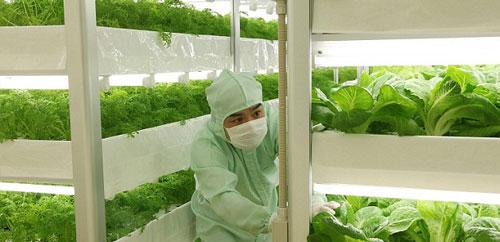
Imagine this: Shelves upon shelves of ideal lettuce, all grown within a sterilized environment, while scientists in gloves, surgical masks, and protective suits meticulously examine each plant for perfection. Sounds like something in a science fiction film? Not so much. Scientists in Japan and Taiwan have been working in plant factories throughout the country to create the most immaculate looking lettuces and green leaves 24 hours a day, seven days a week.

Also known as PFALs, or plant factories with artificial light, these factories are made of six components: a thermally insulated, airtight warehouse-like opaque structure, four to twenty tiers (layers) equipped with hydroponic culture beds, lighting devices such as fluorescent and LED lamps, air-conditioners with air fans, CO2 supply unit, nutrient solution supply unit with water pumps, and environment control unit, according to a p-Watch-Japan article. These processes control every part of the plant’s environment, including lighting, temperature, humidity, water, and CO2, allowing scientists to grow the perfect vegetable.
 Not only are these plants produced without pesticides, their life span after harvest is two times longer than those produced in a greenhouse, according to a p-Watch-Japan article. In addition, because these plants are grown in a completely sterile environment, they are uncontaminated by dirt, insects, or fresh air, protecting them from harmful weather and allowing them to be eaten safely without washing, according to DailyMail UK. Lettuce grown in the factories can be cropped up to 20 times a year.
Aside from creating the perfect lettuce, these plant factories are highly advantageous because resources can be used more efficiently than greenhouses, according to Taiwan Today. For example, while water from a greenhouse is typically drained or evaporated, condensed water is eventually captured in air conditioners and reused on plants.
Nevertheless, although one of the problems still facing these factories today is their high setup costs, could the return be worth the investment? Despite the limited amount of crops that can be grown in these factories, the future may hold better tasting, cleaner, and potentially fresher vegetables than ever before.