Email Vertical




|
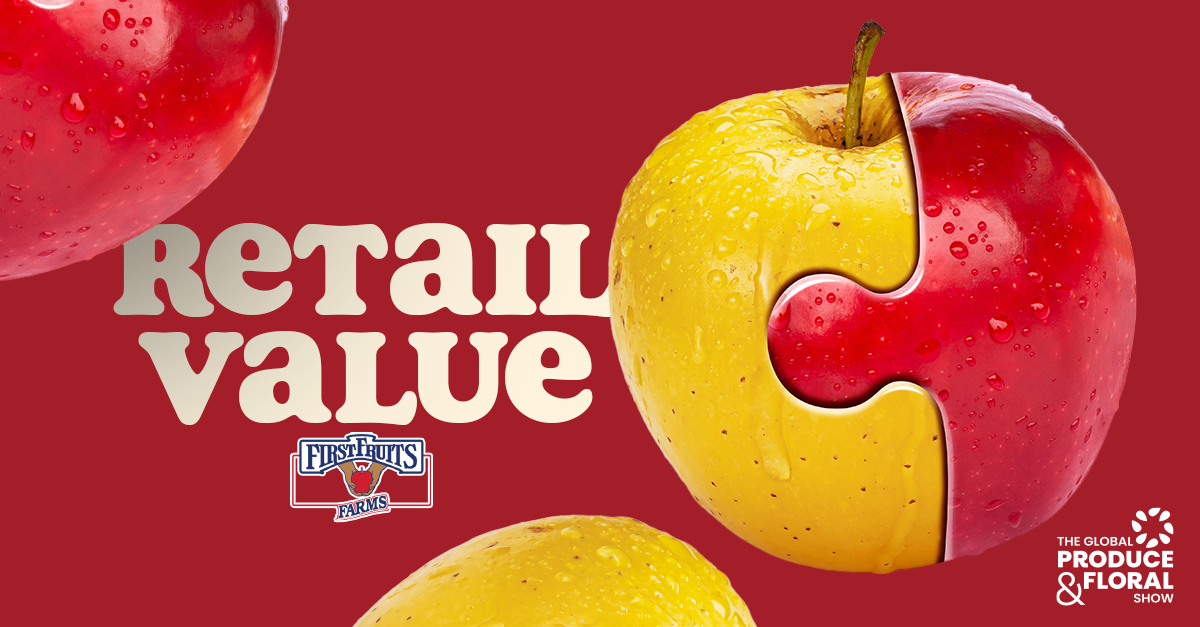
YAKIMA, WA - From assortment strategies to positioning and promotions, a vertically integrated apple category partner can make all the difference in the highly competitive treefruit space and an even more dynamic market. FirstFruits, a company focused on growth that supports success for both partners and consumers, is priming its messaging around supply-side solutions from the farm to the produce department, and IFPA’s Global Produce & Floral Show (GPFS) is the place to see it all come together.

“This year marks our third year exhibiting as FirstFruits at GPFS, and it is an opportunity to showcase how we continue to grow as one integrated team across two growing regions,” President Chuck Zeutenhorst shares. “With apples grown in both Washington and Michigan, we can provide a strong mix of core varieties alongside sought-after club and proprietary varieties. From dependable favorites to newer varieties that create excitement, our goal is to help customers build an apple assortment that meets different shopper preferences and creates more sales opportunities.”
FirstFruits has evolved in recent years and now encompasses both FirstFruits Farms in Washington and Applewood Fresh in Michigan. This gives customers access to a broader, more flexible apple program.

To bring even more joy to the apple destination, FirstFruits is also showcasing its Opal Smiles program, a new consumer engagement campaign launching with this year’s Opal season. Turning the apple’s PLU sticker into an opportunity for shoppers to engage with the brand, Opal Smiles fans can collect stickers and unlock rewards year-round—encouraging repeat purchases.
“Sustainability and organic production will also be part of the conversation. We have expanded our organic acreage in Washington, reflecting our continued investment in growing practices and meeting evolving customer and consumer demand,” Chuck expands. “One of the biggest things that sets FirstFruits apart is our multi-regional apple supply. With growing operations in both Washington and Michigan, we can bring together fruit from two distinct growing regions under one integrated organization.”
Vertical integration is another key differentiator. Both FirstFruits and Applewood have ownership and oversight across the growing, packing, and sales process, giving FirstFruits greater visibility and control over the fruit moving through its system.

“That connection from orchard to customer allows us to maintain consistent standards while providing greater traceability and accountability throughout the supply chain,” Chuck tells me. “Our variety portfolio is another important piece of that equation. We offer both core apple varieties that shoppers know and love, and club and proprietary varieties that can help retailers differentiate their assortment and create new reasons to purchase.”
At this point, Chuck turns to the solution-building part of the company in the face of today’s produce industry challenges. From supply-chain complexity and changing consumer expectations to the need for retailers to make every SKU and promotional opportunity count, FirstFruits’ integrated model is designed to help customers navigate those challenges with greater consistency, visibility, and flexibility.

“We recognize that success today depends on understanding the consumer, not just the supply chain. Our marketing team uses category data, shopper insights, and industry trends to help customers better understand their product mix and the shopper journey through the produce department,” Chuck reflects. “We turn those insights into actionable recommendations around assortment, positioning, and promotion, then support those strategies with creative marketing programs designed to engage shoppers and drive apple sales.”
Attendees can expect to meet members of the FirstFruits team across sales, marketing, and growing operations. Make sure to visit booth #3977 and learn more about this multi-region apple trailblazer.
See you all at the show!


ISSAQUAH, WA - Costco Wholesale Corporation announced its operating results for the 16-week fourth quarter and the 52-week fiscal year ended August 30, 2026.
Net sales for the quarter increased 11.2 percent, to $93.9 billion, from $84.4 billion last year. Net sales for the fiscal year increased 10.1 percent, to $297.2 billion, from $269.9 billion last year, stated in a press release.
Net income for the fourth quarter was $2.998 billion, $6.75 per diluted share, compared to $2.610 billion, $5.87 per diluted share, last year. This year’s fourth quarter was positively impacted by a non-recurring benefit of $0.15 per diluted share from IEEPA tariff refunds received in the quarter, less partial reinvestment of those refunds in increased member values. Net income for the fiscal year was $9.226 billion, $20.76 per diluted share, compared to $8.099 billion, $18.21 per diluted share, last year.

Costco currently operates 939 warehouses, including 647 in the United States and Puerto Rico, 115 in Canada, 43 in Mexico, 37 in Japan, 29 in the United Kingdom, 20 in Korea, 15 in Australia, 14 in Taiwan, seven in China, five in Spain, three in France, two in Sweden, and one each in Iceland and New Zealand. Costco also operates e-commerce sites in the U.S., Canada, the U.K., Mexico, Korea, Taiwan, Japan, Australia, and China.