

Does your company's packaging have a spokes-character? Does that character make eye contact with consumers?
In a recent Cornell University study, breakfast cereal spokes-characters were found to be making eye-contact with their target audience, and this increased brand trust by 16% and the feeling of connection with the brand was 28% higher.
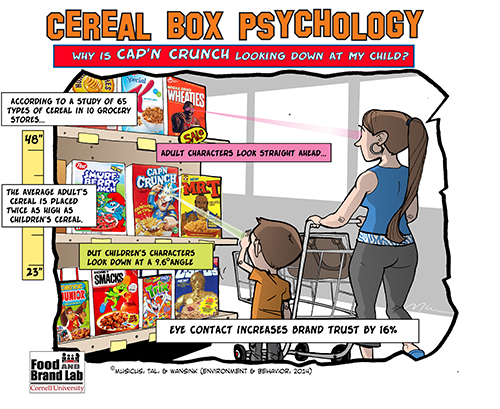
For 65 types of cereals with 86 different spokes-characters in 10 different grocery stores, researchers studied the differences between cereals marketed to children and those marketed to adults, according to the Food and Brand Lab at Cornell University.
The conclusions were that kids cereals are placed half as high on the supermarket shelves (on average, 23 inches for kids versus 48 inches for adults), and that the average angle of the gaze of cereal spokes-characters on cereal boxes is downward for kids at a 9.6° angle, whereas spokes-characters for adult cereals look almost straight ahead.
For each character, the angle of the gaze was calculated four feet from the shelf, which researchers say is the standard distance from which shoppers view boxes. Of the 86 different spokes-characters studied, 57 were marketed to children with a downward gaze at an angle of 9.67°.
In another study, researchers sought to understand the extent to which eye contact with cereal characters influences feelings of trust and connection with a brand. 63 individuals participated in the study. They were asked to view a Trix cereal box and rate their feelings about the brand. Subjects were randomly shown one of two versions of the box, with the rabbit either looking straight ahead or else looking down.
The findings concluded that brand trust was 16% higher and the feeling of connection with the brand was 28% higher when the rabbit made eye contact. Subjects also reported liking Trix better compared to another cereal, when the rabbit made eye contact. This indicates that eye-contact from characters on packaging can increase positive feelings towards a product and encourage consumers to buy it.
Spokes-characters who make eye contact with the target audience are obviously a well-known marketing tactic within the cereal industry. It is not a stretch to suggest that these same strategies could be implemented by the fresh produce industry.
If making eye contact with children can help create brand loyalty, why not take advantage of this principle to get kids to eat something healthy?