






















Harvest is officially rolling...
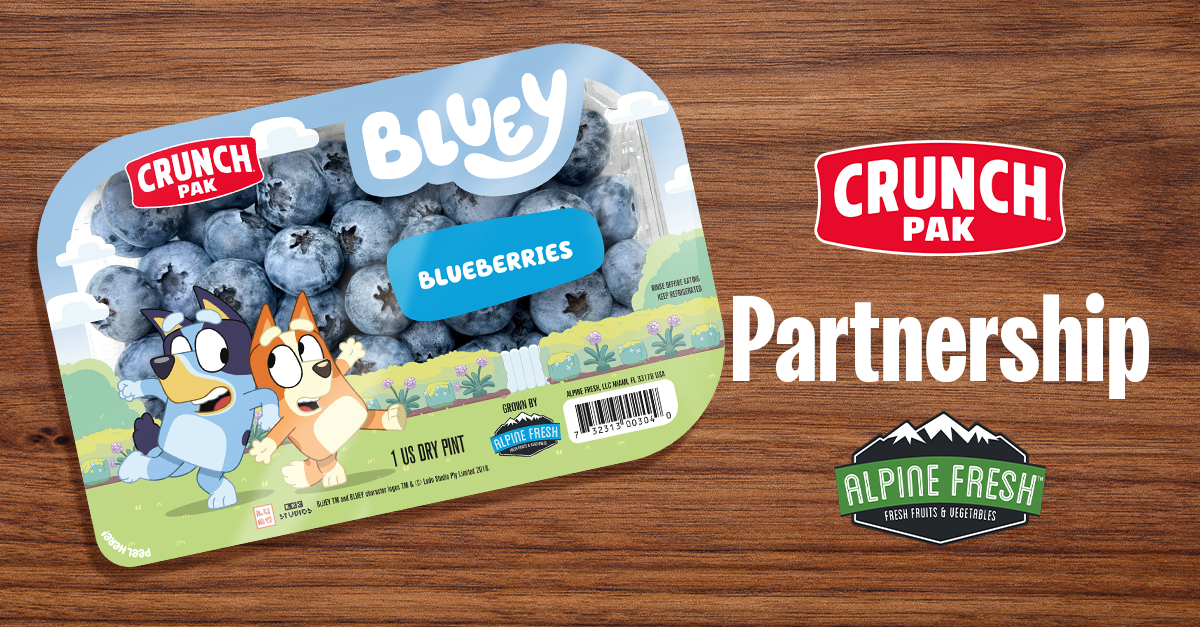
CASHMERE, WA - Crunch Pak®, a leader in licensed fresh produce and snacking solutions, and Alpine Fresh, a premier grower and distributor of fresh fruits and vegetables, have partnered to launch a first-to-market Bluey™ branded blueberry program.
Launching at the end of August, shoppers will find fresh blueberries featuring Bluey, one of the world's most beloved entertainment properties, on specially designed pint packaging created to bring added fun and familiarity to the produce department. Building on the momentum of Crunch Pak’s Bluey organic apple program, the blueberry launch expands the character-driven fresh produce platform into the berry category at retail.
The collaboration brings together Crunch Pak's expertise in licensed produce programs and Alpine Fresh's commitment to delivering premium-quality blueberries, creating a product designed to engage families, encourage consumption, and stand out at shelf through fully integrated packaging.
"Bluey has become a trusted favorite among families, making it a natural fit for the fresh produce category," said Jay Zimmerman, Licensing and Innovation Manager at Crunch Pak, in the recent release. "Our goal is to create products that make healthy choices more engaging for kids while providing retailers with innovative programs that capture shopper attention and drive excitement in the produce aisle."

The Bluey blueberry pints are designed to offer parents a nutritious snack option while providing children with packaging featuring characters they know and love. Unlike a standard sticker application, the program uses a custom top-seal film that integrates Bluey artwork directly into the package design, creating a more premium, ownable presentation and helping the product command attention in the refrigerated berry set.

"Bluey is one of the most recognizable family brands in the marketplace today, making it a powerful vehicle for driving consumer engagement in fresh produce," said Ashley Yager, Director of Marketing, Alpine Fresh. "This partnership provides retailers with a unique merchandising opportunity that differentiates the berry category, attracts young families, and reinforces the value of fresh fruit as an everyday choice for families. We're proud to work alongside Crunch Pak to bring this innovative program to market and make it available to retail partners looking to add excitement to the berry set."
Licensed produce programs continue to create opportunities for retailers to differentiate their assortments and connect with family shoppers. Through this partnership, Crunch Pak and Alpine Fresh aim to inspire more produce purchases while delivering a fun, engaging shopping experience.
|
LEAMINGTON, ON - One of my favorite things about the fresh produce industry is that we are always thinking about the next generation. Designed for up-and-coming leaders in produce, SEPC’s Next Generation Leadership Academy (NGLA) arms participants with the leadership skills needed to navigate evolving industry challenges with a growth mindset. Paul Williamson, Account Manager at Highline Mushrooms, recently reflected on the transformational experience provided by this year-long professional development program.
Paul, what does it mean to you to be part of the Next Generation Leadership Academy?

“With the support of Highline Mushrooms, I was given the opportunity to participate in the Next Generation Leadership Academy. Highline's commitment to investing in people allowed me to focus on the program and grow both personally and professionally.
I entered the program with an open mind and no real expectations, just a willingness to learn, listen, and grow.
Looking back over the past year, I can honestly say the experience has changed me in many ways. It challenged how I think about leadership, how I communicate, and how I approach difficult situations. More importantly, it gave me greater confidence in myself and in my ability to help others grow.
The relationships I built with people across the program have been incredibly valuable, both personally and professionally. They have become true friends, trusted peers, and a group I know I can rely on. Together, we have built a strong sense of trust, support, and shared purpose.
NGLA has given me the confidence to keep becoming the kind of leader I aspire to be. I know I am still on an amazing journey, and I am truly grateful to have been selected.”

What is the most important lesson you have learned so far?
“The biggest lesson I have learned is that before you can effectively lead others, you need to understand yourself first.
Whether you are leading your family, your community, or a team at work, self-awareness is the foundation of strong leadership. I also realized that growth happens when you lean into situations that make you uncomfortable. Really highlighting that vulnerability is not a weakness; it absolutely allows you to learn, build trust, and become a better leader.
If I could share one lesson with others, it would be this: have the courage to face the things that make you uncomfortable. Often, that is where your greatest personal and professional growth happens.”
How do you envision the future of produce leadership?
“I believe the future of produce leadership will be built on collaboration, courage, and putting people first.
Every person we work with is dealing with their own challenges. As leaders, we need to remember to be human, support one another, and create workplaces where people feel comfortable speaking up, sharing ideas, and learning from mistakes.
Sometimes our instincts tell us something is not right before we have all the facts. It takes courage to ask difficult questions or challenge the status quo, but that kind of leadership creates stronger teams and better outcomes.”

How do you hope to further evolve your own leadership following the NGLA program?
“My own journey into the produce industry was not traditional. I started my career in IT before moving into packaging and eventually into fresh produce. Along the way, I have experienced both the very best and some of the more challenging sides of our industry. Those experiences have shaped the type of leader I want to become: someone who creates an environment where people feel respected, supported, and encouraged to grow.
Most importantly, I never lose sight of why we do what we do. Every day, our industry provides fresh, healthy, nutritious food to millions of people across North America. I am proud to tell my children this is the industry I work in and that, in some small way, I am helping feed families. That is meaningful to me.
As I continue to develop as a leader, my goal is simple: to leave the industry better than I found it. I have seen some of the more difficult aspects of our industry, and those experiences have reinforced my commitment to creating a more positive, collaborative, and supportive environment for others. If I can help the next generation of leaders feel valued, have better experiences, and build long, successful careers in produce, I will consider that one of my greatest achievements.”
Cheers to our industry for continuing to sow the seeds of growth and leadership evolution, one collaborative effort after another.

UNITED STATES - U.S. melon markets were largely steady across major shipping regions, while select California watermelon and cantaloupe sizes moved slightly higher, according to the USDA National FOB Review issued August 17, 2026.
In Delaware, Maryland, and Eastern Shore Virginia, watermelon demand was moderate, and the market was about steady, with a wide range in pricing. Red Flesh Seedless watermelons in 24-inch bins ranged from $105 to $126 for 36s, mostly $112 to $119; $112 to $126 for 45s, mostly $112 to $120; and $112 to $126 for 60s, mostly $112 to $119. Some prior commitments reached $133 for 36s and 60s and $130 to $140 for 45s.

Michigan reported light supplies, moderate demand, and an about steady watermelon market. Wet fields curtailed some morning harvest. Red Flesh Seedless watermelons in 24-inch bins ranged from $161 to $175 for 36s, 45s, and 60s, mostly $161, with occasional lower pricing. Some sales included prior commitments.
In North Carolina, watermelon demand was moderate, and the market was about steady. Red Flesh Seedless 36s ranged from $98 to $119, mostly $100 to $112, while 45s and 60s ranged from $100 to $119, mostly $105 to $112. Occasional lower pricing was reported, while some prior commitments ranged from $126 to $133.

California’s San Joaquin Valley saw mixed movement across its melon categories. Conventional cantaloupe markets were slightly higher amid moderate demand, while organic markets were about steady. Conventional half-cartons of 9s ranged from $6 to $7.95, mostly $6.50 to $7.50, while 12s ranged from $6.50 to $8.50, mostly $7 to $8. Organic 9s and 12s ranged from $13 to $16, mostly $13 to $14.
San Joaquin Valley honeydew demand was moderate, and the market was about steady. Conventional two-thirds cartons of 5s and 6s ranged from $5.95 to $8, mostly $6 to $7. Organic 5s and 6s ranged from $13 to $16, mostly $13 to $14.

California watermelon demand was fairly good for approximately 36- and 45-count fruit and moderate for approximately 60-count fruit. Markets for 36s and 45s were slightly higher, while 60s were about steady. Red Flesh Seedless 36s ranged from $133 to $154, mostly $140 to $147; 45s ranged from $133 to $147, mostly $140 to $147; and 60s ranged from $112 to $133, mostly $119 to $126.
In Southwest Indiana and Southeast Illinois, watermelon demand was fairly light, and the market was about steady, with some morning harvest curtailed due to wet fields. Red Flesh Seedless 36s and 45s ranged from $119 to $126, with occasional lower pricing. Prior commitments ranged from $133 to $154 for 36s and $140 to $154 for 45s, with occasional higher pricing. The 60-count fruit ranged from $112 to $126, mostly $112 to $119, while some prior commitments reached $133 to $154, with occasional higher pricing.

Texas watermelon demand was moderate, and the market was about steady, with a wide range in quality and condition. Red Flesh Seedless 36s ranged from $125 to $155, mostly $130 to $140, while 45s ranged from $135 to $155, mostly $135 to $140. Supplies of 60s were insufficient to establish a market.
Stay tuned to AndNowUKnow as we continue tracking melon demand and market movement.
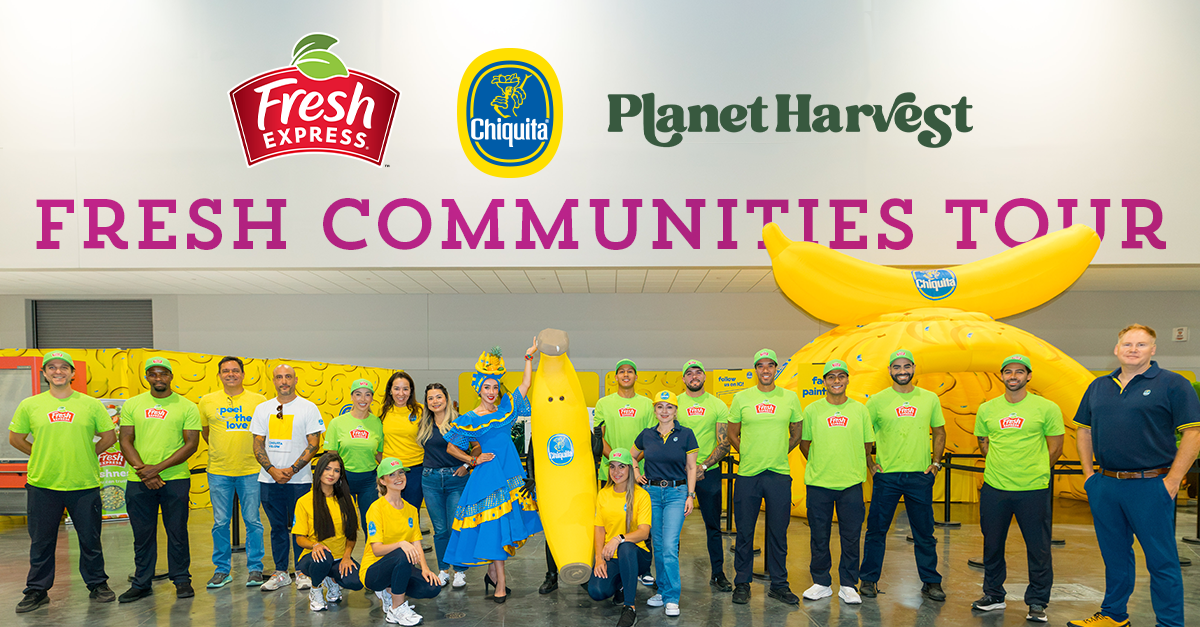
CHICAGO, IL - Fresh Express, Chiquita, Planet Harvest and World Vision are bringing the Fresh Communities Tour to Chicago, Streamwood and the surrounding areas, uniting leaders across the food system to help expand access to fresh food, nutrition resources and meal inspiration for approximately 1,500 families across the region.

On Saturday, June 20, Fresh Express invites community members to join in the fun! Chicago Avenue will be shut down for a welcoming community celebration, bringing together families, volunteers, and community leaders for a day centered on fresh food and connection. Through culinary demonstrations, meal inspiration, and hands-on volunteer engagement, the event aims to create a meaningful experience that extends beyond food distribution.

"At Fresh Express, we believe everyone deserves access to fresh, nutritious food," said John Olivo, President of Fresh Express, in the recent release. "Fresh Communities Chicago brings together organizations that share a commitment to supporting families and strengthening communities. We're proud to work alongside our partners to provide fresh food, practical meal inspiration, and resources that can help make healthy eating more accessible while supporting the communities where our employees live and work.”
As part of the initiative, families will receive food boxes filled with fresh fruits and vegetables, Fresh Express salad kits, Chiquita® bananas, and pantry staples. They will also receive recipe ideas and nutrition resources to help make healthy meals at home more approachable.

"We're proud to bring together partners from across the food system to create meaningful local impact," said Melissa Ackerman, CEO of Planet Harvest. "Fresh Communities Chicago is about more than just providing food. It's about helping families access fresh ingredients while building stronger, healthier communities.”
Fresh Communities Chicago will also spotlight the contributions of Fresh Express employees at the company's Streamwood facility, whose work helps deliver fresh produce to consumers across the region every day.

Marking an important milestone in the continued growth of the Fresh Communities initiative, the event brings together produce companies, nonprofit organizations, and local partners to expand access to fresh food and nutrition resources in communities across the country. Through ongoing activations throughout the year, Fresh Express, Chiquita, Planet Harvest, and World Vision remain committed to creating meaningful local impact and helping more families access the food and support they need to thrive.

SACRAMENTO, CA - My youngest has been on a sweet potato kick lately. Roasted, mashed, tucked into a quesadilla—he'll eat them any way I put them in front of him, and I've found myself buying a few extra every week, grateful they're there.
What I didn't fully appreciate, until I started talking to people who grow them, is how much heavier that bounty feels on the other side of the bin.

California's sweet potato growers—who account for roughly 25 percent of U.S. production, primarily out of Merced, Stanislaus, and Kern counties—are navigating a market that has more root than it needs right now. Acreage in the state has dropped from more than 21,000 acres to about 18,000 over the past five years, and four packing sheds have closed in that same window. That's not a footnote. That's a structural shift.
The pressure comes from multiple directions at once. Foodservice demand doesn’t return the same margin compared to retail —sweet potato fries, still a rising star on restaurant menus, don’t give the category enough umph to triumph the bin. Input costs climbed. Labor, fertilizer, compliance—every sweet potato is hand-placed into a bin at harvest, which means there's no squeezing the human element out of the equation.

Water, for years the defining anxiety of California agriculture, has shifted in its own complicated way. The state was declared drought-free in early 2026 for the first time in a quarter-century—good news on its face, and genuinely meaningful for irrigation planning after years of scarcity. But groundwater recovery takes far longer than a wet season to register, and Colorado River renegotiations are expected to reduce California's long-term allocations regardless. Relief and uncertainty, arriving together.
What I keep returning to, talking to people across this industry, is that the growers still here made a choice to stay. That's not nothing. Acreage went down, sheds closed, margins compressed — and they're still in the ground, still finding ways to differentiate, still investing in what they believe the market will need. I'm grateful for the suppliers who stayed in this when the math argued against it. The least we can do is savor every bite.
That kind of resilience doesn't have a line on a USDA pricing report.
But it should be part of how we read one.
Breaking down the perfect cherry sweetness...

WASHINGTON, DC - The U.S. Department of Agriculture (USDA) has imposed sanctions on three produce businesses for failing to meet contractual obligations to the sellers they purchased produce from and failing to pay reparation awards issued under the Perishable Agricultural Commodities Act (PACA). These sanctions include suspending the businesses’ PACA licenses and barring the principal operators from engaging in PACA-licensed business or other activities without USDA approval.
The following businesses and individuals are currently restricted from operating in the produce industry:
- Raul Distributor Inc., operating out of Bronx, N.Y., for failing to pay a $48,234 award in favor of a Florida seller. As of the issuance date of the reparation order, Raul Martinez was listed as the officer, director, and major stockholder of the business.
- Southern Kraze Farms LLC, operating out of Timberlake, N.C., for failing to pay a $128,089 award in favor of an Alabama seller. As of the issuance date of the reparation order, Orin Long was listed as a member of the business.
- Triple C Produce & Logistic LLC, operating out of Humble, Texas, failed to pay a $41,257 award in favor of a Texas seller. As of the issuance date of the reparation order, Eliezer Manzo, Carlos Escobar, and Gana Sales LLC were listed as members of the business.
PACA provides an administrative forum to handle disputes involving produce transactions; this may result in USDA’s issuance of a reparation order that requires damages to be paid by those not meeting their contractual obligations in buying and selling fresh and frozen fruits and vegetables.
USDA is required to suspend the license or impose sanctions on an unlicensed business that fails to pay PACA reparations awarded against it as well as impose restrictions against those principals determined to be responsibly connected to the business when the order is issued. Those individuals, including sole proprietors, partners, members, managers, officers, directors or major stockholders, may not be employed by or affiliated with any PACA licensee without USDA approval.
By issuing these penalties, USDA continues to enforce the prompt and full payment for produce while protecting the rights of sellers and buyers in the marketplace.
For more information, contact Penny Robinson-Landrigan, PACA Dispute Resolution Branch, at (202) 720-2890 or [email protected].
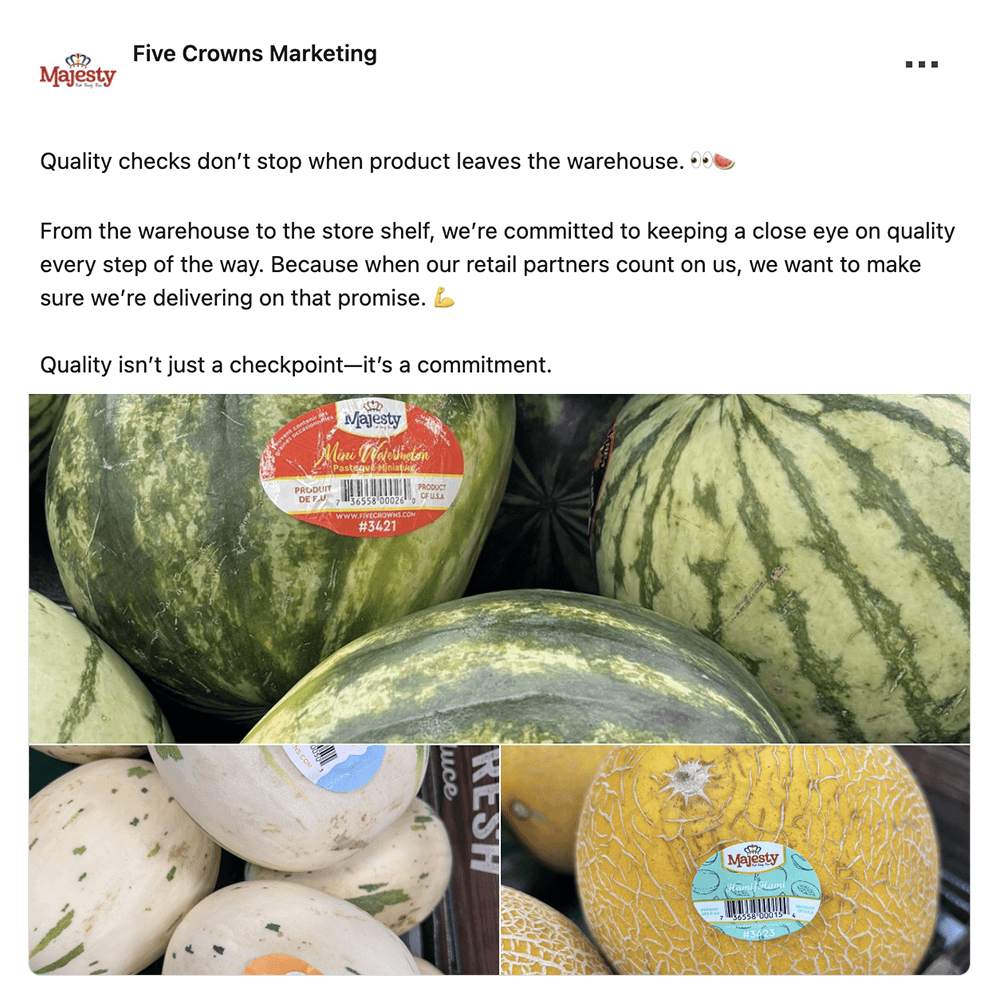
A look ahead at winter melons...